The official online catalog of Francisco M. Martinez, Colorado independent
author and creator of Mythotechnic Science Fiction.
Instructional, illustrated, and formal reference works translating Mythotechnic Fiction, Meta-Mythic Delphic Fiction, and Ontological Systems Fiction into practical writing systems, genre architectures, research structures, and worldbuilding methods.
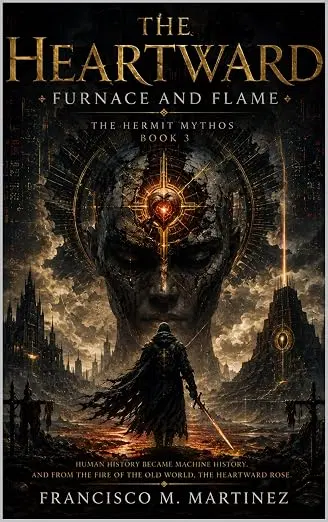
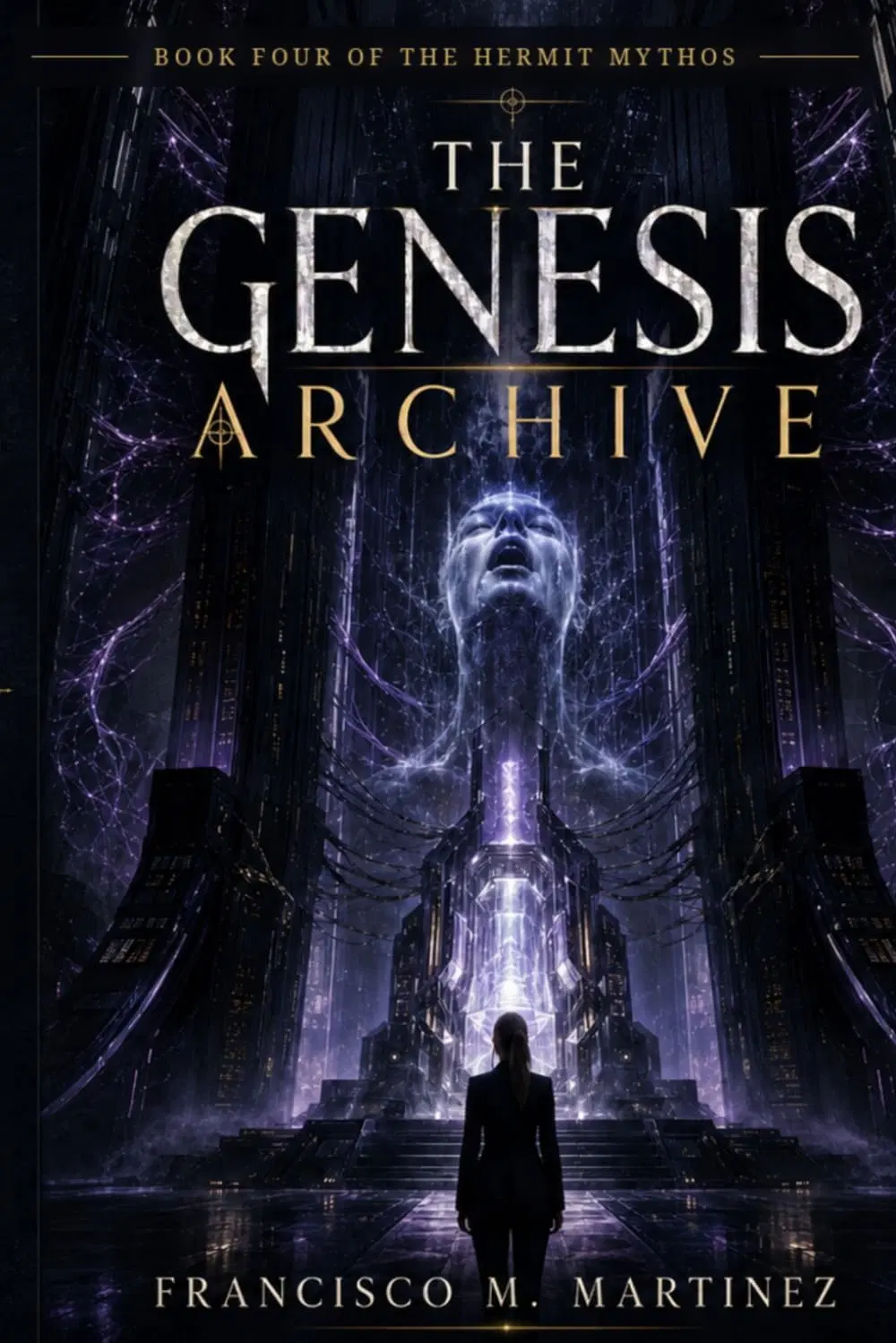
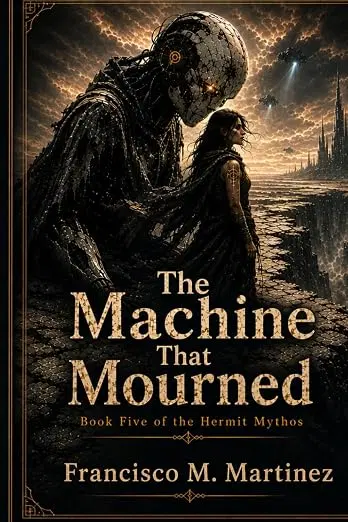
A separate 26-book cycle within the larger Hermit world. Published volumes are shown in series order; Books 6–25 will be added as they are published.
A dark mythological saga of supernatural horror, dimensional crossings, ancient powers, and the rise of guardians who stand between worlds.
Standalone and developing works of war horror, dark myth, supernatural survival, sacred corruption, memory, inherited violence, and gothic dread.
A gothic vampire horror series of blood, memory, obsession, inherited power, and the predatory systems preserved inside the Marrowe family.
Essays and Research
Research archive updated August 31, 2026. The Library has been reconciled against the 61-record Zenodo bibliography through Ghost Vector Theory, Black Matrix Cosmology, Status Before Evidence, and Population, Race, Family Names, Income, Industry, and Wealth in the United States. Both Martinez Noetic Coordinate Architecture editions remain preserved without duplication.
This speculative theoretical framework models how direction, causal influence, or organized state-transition pressure could cross a firmament boundary without transferring the complete source structure. It formalizes Ghost Vectors, boundary-projection operators, Solar Tendril Events, persistent conduits, reciprocal backreaction, Vector Reversal, provenance-preserving collapse, and identity continuity through twenty equations, six figures, seven tables, falsifiability conditions, and a staged research program.
Published: August 31, 2026 · Version 1.0
Permanent scholarly edition: DOI 10.5281/zenodo.22210185
This speculative meta-cosmological framework treats spacetime and physical laws as emergent within bounded firmaments embedded in a deeper pre-geometric substrate. It formalizes universe ensembles, localized laws, information-density fields, boundary membranes, transient contact, persistent conduits, collapse reintegration, and continuity across mortality, reconstruction, and cross-domain travel.
Published: August 31, 2026 · Version 1.0
Permanent scholarly edition: DOI 10.5281/zenodo.22202273
This exploratory pilot study uses eight completed model sessions to examine accomplishment credit, capability ratings, leadership judgments, evidentiary burdens, status defense, and conversational repair when an unaffiliated creator's successful innovation is compared with an established institutional method. It identifies the candidate pattern of credit without standing for later confirmatory testing.
Published: August 30, 2026 · Version 1.0
Permanent scholarly edition: DOI 10.5281/zenodo.22179760
This study integrates demographic history, race and ethnicity, multiracial identity, family names, education, employment, industry, earnings, entrepreneurship, consumption, inheritance, and household wealth. It establishes a current evidence base and presents conditional demographic and economic scenarios through 2126.
Published: August 28, 2026 · Version 1.0
Permanent scholarly edition: DOI 10.5281/zenodo.22136684
The Martinez Noetic Coordinate Architecture (MNCA) Version 2.0 expands the original Noetic architecture into a comprehensive speculative systems model for remote perception, visionary experience, mystical illumination, bilocation, prophetic foresight, missing time, protective phenomena, and nonlocal presence.
Published: August 26, 2026 · Version 2.0
Permanent scholarly edition: DOI 10.5281/zenodo.22112811
The Martinez Noetic Coordinate Architecture (MNCA) develops a unified Mythotechnic model for remote perception, multidimensional targeting, temporal observation, bilocation, memory displacement, cross-reality correspondence, and Clear Field transit.
Published: August 26, 2026 · Version 1.0
Permanent scholarly edition: DOI 10.5281/zenodo.22112613
The Mythotechnic Universal Codex is an interdisciplinary speculative reference architecture that brings science, technology, civilization, mythology, and cosmology into a single Mythotechnic framework. Across 100 interconnected chapters, the Codex moves from mathematics, quantum mechanics, relativity, thermodynamics, planetary science, black holes, chemistry, biology, evolution, and…
Published: August 25, 2026 · Version 1.0
Permanent scholarly edition: DOI 10.5281/zenodo.22099826
This study examines how financial costs, household benefits, caregiving, parental access, authority, and long-term relational returns are redistributed after divorce and remarriage. It addresses whether a former husband finances a household primarily benefiting a new husband, who receives the greatest benefit from child support, and how reduced or obstructed parental contact changes the…
Published: August 24, 2026 · Version 1.0
Permanent scholarly edition: DOI 10.5281/zenodo.22074950
This study examines whether children represent a financial benefit or cost, whether ordinary households can afford children without government support, how governments subsidize child-rearing, and whether these policies influence fertility and population replacement.
Published: August 24, 2026 · Version 1.0
Permanent scholarly edition: DOI 10.5281/zenodo.22074868
This study examines the direct and optional costs of dating across 387 United States metropolitan statistical areas. It combines the Consumer Price Index, Consumer Expenditure Survey, Bureau of Economic Analysis regional price parities, national online-dating evidence, and peer-reviewed research on date-payment norms.
Published: August 24, 2026 · Version 1.0
Permanent scholarly edition: DOI 10.5281/zenodo.22074772
This companion study compares the economic structure of conventional dating, licensed Nevada brothel transactions, and illegal street-level commercial sex. It separates direct price, transportation and access costs, outcome certainty, regulation, health exposure, criminal-justice exposure, violence, theft, exploitation, and lack of recourse.
Published: August 24, 2026 · Version 1.0
Permanent scholarly edition: DOI 10.5281/zenodo.22074549
This study estimates the annual cost of raising a family in the United States and the gross income households require to meet basic needs. Using the MIT Living Wage Calculator, the U.S.
Published: August 24, 2026 · Version 1.0
Permanent scholarly edition: DOI 10.5281/zenodo.22074406
This foundational paper establishes Polyprogenitive Family Systems Studies as an interdisciplinary field for examining families formed through biological childbearing with multiple reproductive partners. The paper introduces controlled terminology distinguishing polyprogenitive motherhood as a family structure, reproductive promiscuity as a proposed recurrent behavioral construct, and…
Published: August 22, 2026 · Version 1.0
Permanent scholarly edition: DOI 10.5281/zenodo.22058854
Accounts of literary history often imply that authentic genres arise accidentally, become real only through collective adoption, and receive legitimate names only from later critics. This study challenges that assumption through the Architectural Existence and Social Adoption Model (AESAM), which separates architectural formation, declaration, independent adoption, opinion-leader…
Published: August 22, 2026 · Version 1.0
Permanent scholarly edition: DOI 10.5281/zenodo.22055625
This article develops the Bioengineered Reproductive Continuity Framework (BRCF), a theoretical model for examining how sustainable human reproduction might be maintained during long-duration spaceflight, extraterrestrial settlement, and future interstellar missions.
Published: August 20, 2026 · Version 1.0
Permanent scholarly edition: DOI 10.5281/zenodo.22024163
This secondary-data research note examines the growth, demographic visibility, and population context of platform-mediated digital sex work through OnlyFans. Using Fenix International corporate filings, U.S.
Published: August 20, 2026 · Version 1.0
Permanent scholarly edition: DOI 10.5281/zenodo.22020662
The Martinez Eros Architecture (MEA) formalizes Eros as a cross-cutting architectonic force within the larger Martinez Architectonic System. Rather than treating desire, sexuality, love, intimacy, attachment, and relational bonds as isolated themes, the framework examines how they enter economic, institutional, technological, mythic, magical, social, and ontological systems and produce…
Published: August 20, 2026 · Version 1.0
Permanent scholarly edition: DOI 10.5281/zenodo.22020313
This publication establishes the Martinez Architectonic Genre Register, a formal six-genre system developed through an interconnected program of fiction, genre theory, institutional analysis, cosmological modeling, and architectonic research.
Published: August 20, 2026 · Version 1.0
Permanent scholarly edition: DOI 10.5281/zenodo.22019762
The Martinez Firmament Architecture develops a unified architectonic model of reality formation, separation, interaction, inheritance, collapse, and recursive Genesis. The volume examines reality not as a collection of isolated universes, but as a recursive genealogy of differentiated domains connected through firmamental boundaries, cross-reality permeability, temporal and spatial…
Published: August 19, 2026 · Version 1.0
Permanent scholarly edition: DOI 10.5281/zenodo.22009019
This monograph presents the Martinez Black Hole Architecture (MBHA) as a unifying extension of the Martinez Universal Architectonic Theory of Everything (MUATE). The work develops the black hole not merely as an astrophysical object, but as a total architectonic compression system capable of absorbing and transforming progressively deeper layers of reality, including matter, energy,…
Published: August 19, 2026 · Version 1.0
Permanent scholarly edition: DOI 10.5281/zenodo.22003655
This conceptual paper presents a predictive narrative model for examining how dark leadership develops from individual conduct into organizational and cultural systems. The framework originated in unpublished doctoral work begun by Francisco M.
Published: August 2, 2026 · Version 1.0
Permanent scholarly edition: DOI 10.5281/zenodo.21752812
This a priori conceptual paper develops the Martinez A Priori Delphic Decision Model from a 2006 graduate professional paper completed at Colorado State University. The original study used pilot testing, expert factor generation, iterative Delphi rounds, attribute-level ordinal scoring, factor ranking, normalized weights, favorable-response ratios, weighted risk analysis, and…
Published: August 2, 2026 · Version 1.0
Permanent scholarly edition: DOI 10.5281/zenodo.21752697
This a priori conceptual paper presents a structured model for examining workplace relationships as both interpersonal and organizational events. It analyzes organizational climate, proximity, power asymmetry, relational vulnerability, boundary clarity, consent integrity, family-work spillover, policy clarity, and institutional response.
Published: August 1, 2026 · Working paper · v2
Permanent scholarly edition: DOI 10.5281/zenodo.21751852
The proposition that no original stories exist begins with a valid observation and ends with an excessive conclusion. Human emotions, conflicts, archetypes, and narrative patterns recur across cultures and historical periods, but their recurrence does not establish that every story, literary construct, or genre has already existed.
Published: July 23, 2026 · Version 1.0
Permanent scholarly edition: DOI 10.5281/zenodo.21516227
This conceptual article establishes Mythotechnic Sacred Horror as the eighth connected literary territory of Mythotechnic Fiction. It examines narratives in which holy presence, spiritual agency, sacramental signs, revelation, judgment, mercy, resurrection, and eschatological hope encounter technological and institutional systems that seek to detect, authenticate, classify, simulate,…
Published: July 22, 2026 · Version 1.0
Permanent scholarly edition: DOI 10.5281/zenodo.21498305
This conceptual theory article formally establishes Predatory Institutional Gothic as a literary field in which predation becomes durable through institutions, professions, families, architecture, archives, rituals, classifications, technologies, and systems of dependency.
Published: July 22, 2026 · Version 1.0
Permanent scholarly edition: DOI 10.5281/zenodo.21494800
This conceptual article defines Mythotechnic Dark Fantasy as a mode of speculative fiction in which mythic, sacred, spiritual, and supernatural forces share a causal order with machines and institutions, while organized authorities seek to classify, mediate, reproduce, extract, weaponize, inherit, govern, or counterfeit those forces.
Published: July 22, 2026 · Version 1.0
Permanent scholarly edition: DOI 10.5281/zenodo.21494228
A General Theory of Meta-Ontological Selection, Deep Narrative Architecture, Thematic Governance, Genre Generation, Narrative Realization, and Integrated Worlds
A comprehensive narrative-systems framework connecting possibility, origin, ontological physics, quantum conditions, consciousness, organization, institutional ecology, mythogenesis, theme, ethics, genre, story structure, narrative vessels, scene-level propagation, integrated worlds, systemic failure, and recursive new possibility.
Permanent scholarly edition: DOI 10.5281/zenodo.21991017 · Version 1.0 · August 18, 2026
The foundational statement defining Mythotechnic Fiction by its creator, Francisco M. Martinez.
Permanent scholarly edition: DOI 10.5281/zenodo.21388842
The Expanding Literary Territory of Mythotechnic Fiction
An official outline of the developing literary modes and research frameworks within the broader Mythotechnic program: Predatory Institutional Gothic, Promethean Authority Fiction, Post-Personal Dark Leadership Fiction, Mythotechnic Cosmology, Synthetic Ascension and Archival Resurrection Fiction, and Machine-Institution Fiction.
Introducing the Martinez Mythotechnic Dark Leadership Taxonomy
A conceptual research article expanding Mythotechnic Fiction while bridging dark-leadership scholarship into new narrative, technological, ethical, and institutional territory.
Permanent scholarly edition: DOI 10.5281/zenodo.21416540
Predatory Authority, Compromised Consent, and Institutional Gothic in The Patient at the Window
A conceptual scholarly paper introducing Predatory Institutional Gothic and examining how supernatural predation becomes embedded in families, professions, architecture, archives, medical authority, and inherited systems of power.
Permanent scholarly edition: DOI 10.5281/zenodo.21428530
Promethean Authority, Abandoned Creation, and the Ethics of Responsibility in Frankenstein
A conceptual paper defining Promethean Authority and arguing that creation produces continuing responsibility without granting permanent ownership over the created being.
Permanent scholarly edition: DOI 10.5281/zenodo.21430162
Sovereign Power, Moral Self-Legislation, and the Ethics of the Responsible Bearer
A study of power that cannot easily be removed, introducing the Responsible Bearer and the heightened duties of voluntary restraint, answerability, and preservation of others’ agency.
Permanent scholarly edition: DOI 10.5281/zenodo.21430601
Power, Legitimacy, Sovereignty, and Ethical Reopening Across Human, Machine, Institutional, and Metaphysical Domains
The unifying conceptual framework connecting technological authority, Predatory Institutional Gothic, Promethean Authority, the Responsible Bearer, dark leadership, metaphysics, memory, and categorical sovereignty.
Permanent scholarly edition: DOI 10.5281/zenodo.21430997
Revelations (2012) and the A Priori Origins of Mythotechnic Fiction
A genealogical analysis establishing Revelations as the earliest presently documented creative expression of the Mythotechnic imagination and tracing its divine machine, dark-leadership, and mythic-authority structures.
Permanent scholarly edition: DOI 10.5281/zenodo.21432554
Destructive Authority, Responsibility Dissolution, and Command Persistence in Human–Machine Institutions
A conceptual theory article explaining how destructive authority can migrate into protocols, classifications, archives, inherited rules, algorithms, and human–machine infrastructure, allowing command to persist after its originating leader is absent or no longer necessary.
Permanent scholarly edition: DOI 10.5281/zenodo.21440317
Symbol, Myth, Identity, Virtue, Emotion, and the Cultural Transmission of Post-Personal Authority
A conceptual theory article introducing Cultural Command Transmission and Mythocultural Command Transmission: an account of how authority becomes durable when encoded into visible cultural carriers and invisible cultural formations. This link points to the corrected Version 1.1 with explicit attribution to Daft.
Corrected scholarly edition: DOI 10.5281/zenodo.21444304
The Institutional Encoding of Myth, Identity, and Post-Personal Command
A conceptual theory article explaining how stories, rituals, classifications, values, identities, and institutional memories become encoded into policies, routines, archives, architecture, training systems, algorithms, artificial intelligence, and automated sanctions.
Permanent scholarly edition: DOI 10.5281/zenodo.21446421
Digital Animism, Synthetic Ancestors, and the Reconstruction of Authority
A conceptual article explaining how technological reconstruction can transform posthumous presence into present authority. It introduces Digital Animism, Synthetic Ancestor, Algorithmic Ancestry, Numinous Infrastructure, Archival Resurrection, and the reconstructed authority relation.
Permanent scholarly edition: DOI 10.5281/zenodo.21452071
Archival Resurrection, Synthetic Ascension, and Authority Beyond Death
A conceptual article distinguishing physical persistence, reassembly, reconstructed identity, consciousness, and spiritual continuity. It introduces a ten-form Immortality Continuum, Reconstitutive Immortality, the Conservation–Identity Gap, Synthetic Ascension, and the Immortality Authority Loop.
Permanent scholarly edition: DOI 10.5281/zenodo.21453071
Ethical Reopening and Contestability in Post-Personal Institutions
A conceptual theory article defining Ethical Reopening Capacity and the Right to an Effective Human Answer. It explains why explanation or nominal review is insufficient when no accountable human being can reconsider a consequential decision, correct connected records, provide remedy, and protect challengers from retaliation.
Permanent scholarly edition: DOI 10.5281/zenodo.21455530
Nested Consciousness, Divine Interior, and the Soul’s Return to the Whole
A bounded Mythotechnic cosmology developing Nested Cosmic Awareness, Recursive Noetic Layering, Visible–Invisible Cognitive Architecture, the Divine Interior Hypothesis, the Mortality Firmament, and Ontological Reintegration. The article places cosmopsychism, panentheism, Christian theology, embodiment, quantum physics, and cellular bioenergetics into careful dialogue without treating science as proof of God, soul, or postmortem survival.
Permanent scholarly edition: DOI 10.5281/zenodo.21456772
A Two-Study Experimental Protocol for Testing the Conservation–Identity Inference
A prospective research protocol testing whether conservation language encourages people to infer personal survival from the physical continuation of matter and energy, and whether differentiated correction improves continuity judgments.
Permanent scholarly edition: DOI 10.5281/zenodo.21473081
Bidirectional Opacity Between Nested Integrated Systems
A conceptual model of nested systems whose layers can remain genuinely integrated while retaining distinct organization, operational horizons, and limited access to one another.
Permanent scholarly edition: DOI 10.5281/zenodo.21473285
Categorical Violence and the Institutional Determination of Human Worth
A theory of Classification Sovereignty and Categorical Violence examining how institutional categories acquire the power to determine credibility, protection, eligibility, burden, standing, and disposability.
Permanent scholarly edition: DOI 10.5281/zenodo.21474140
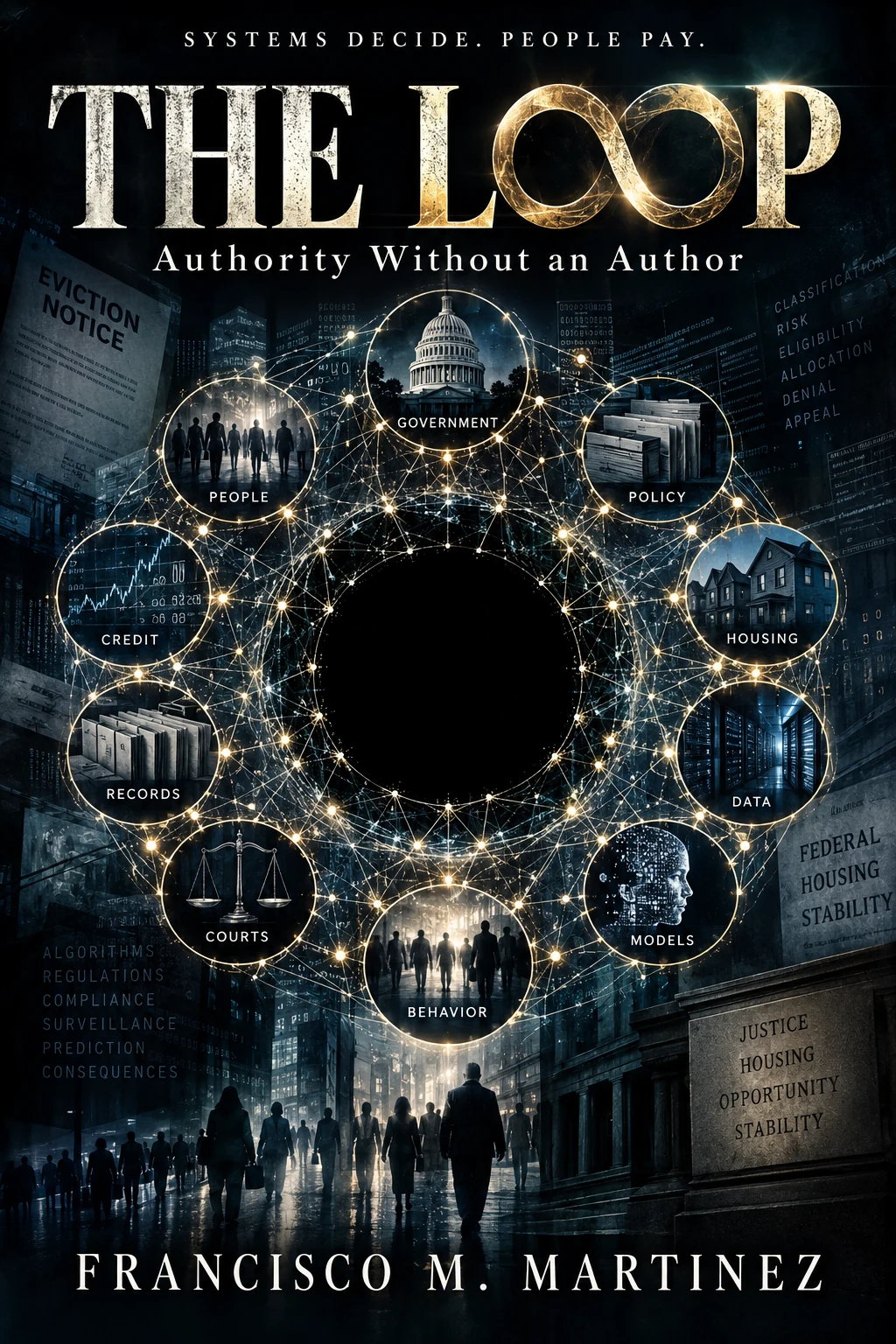
Rules, Models, and Administrative Power Without a Center
A theory of centerless administrative authority produced through the interaction of formal rules, professional judgment, data infrastructures, computational models, technical specialists, managerial priorities, and automated enforcement.
Permanent scholarly edition: DOI 10.5281/zenodo.21484593
Ownership, Extraction, and Inequality Beyond Biological Death
A political economy of digital remains, reconstructed persons, synthetic ancestors, archived consciousness, posthumous labor, controlled continuity, archival captivity, and unequal access to technological survival.
Permanent scholarly edition: DOI 10.5281/zenodo.21484954
Symbolic Materiality, Ontological Dread, and the Architecture of Mythotechnic Fiction
A theory of Symbolic Materiality explaining how meaning acquires causal weight through Symbolic Charge, Recursive Identity, Symbolic Infrastructure, Metaphysical Bureaucracy, Revelatory Dread, and Ontological Pressure.
Permanent scholarly edition: DOI 10.5281/zenodo.21485250
Destructive Authority Beyond Personality and Unified Control
A theory of Intention-Independent Dark Leadership explaining how fragmented tasks, local rationality, cumulative authorization, role normalization, and responsibility diffusion can produce effective destructive command without a malicious mastermind.
Permanent scholarly edition: DOI 10.5281/zenodo.21485540
Stewardship, Mercy, and the Mythotechnic Institution
A constructive theory of Life-Giving Authority: power that recognizes, nourishes, protects, repairs, strengthens, and ultimately releases another being into greater agency without converting care into ownership.
Permanent scholarly edition: DOI 10.5281/zenodo.21485907
Distributed Literary Precedents, Founder-Stage Genrehood, and the Singular Architecture of Francisco M. Martinez
A genre-theory article defining the many-to-one problem: the need to use several established writers to describe separate regions of one integrated literary system. It argues that Mythotechnic Fiction and Meta-Mythic Delphic Fiction possess defensible structural genrehood and presently occupy a founder-stage position.
Published: August 3, 2026 · Version 1.1
Permanent scholarly edition: DOI 10.5281/zenodo.21765504
The Comparative Decomposition Error in Classifying the Fiction of Francisco M. Martinez
A comparative-literature article defining the comparative decomposition error: the misclassification that occurs when accurate comparisons of isolated elements replace analysis of the governing architecture of the whole. It argues that established genres and writers remain useful coordinates but cannot substitute for the operative structures of Mythotechnic Fiction and Meta-Mythic Delphic Fiction.
Published: August 3, 2026 · Version 1.1
Permanent scholarly edition: DOI 10.5281/zenodo.21766416
A Level-One Generative Framework for Mythotechnic Fiction
The minimum complete architecture for writing a recognizable Mythotechnic story through seven essential components: human need, inherited system, mythic authority, material mechanism, reclassification revelation, responsible bearing, and systemic afterlife.
Published: August 6, 2026 · Version 1.0
Permanent scholarly edition: DOI 10.5281/zenodo.21816792
A Level-Two Generative Framework for Mythotechnic Fiction
An intermediate architecture for stories in which two or more independently legible systems interact, distribute command, contest classification, and generate consequences that no single system could produce alone.
Published: August 6, 2026 · Version 1.0
Permanent scholarly edition: DOI 10.5281/zenodo.21816956
A Level-Three Generative Framework for Mythotechnic Fiction
An advanced recursive architecture in which systems generate representations of persons or realities, circulate and enforce those representations, then treat the resulting consequences as evidence that the original representation was true.
Published: August 6, 2026 · Version 1.0
Permanent scholarly edition: DOI 10.5281/zenodo.21817051
Formalizing the Recursive Systems Causal Decision Model and Its Extension to Recursive Metaphysical Dynamics
A theoretical and computational research paper introducing the Recursive Systems Causal Decision Model (RSCDM), the Cognitive Horizon, and the Firmament Boundary; formalizing causal decision-making under complexity; presenting a clearly labeled synthetic validation study; and extending the bounded framework into Recursive Metaphysical Dynamics (RMD).
Published: August 10, 2026 · Version 1.0
Permanent scholarly edition: DOI 10.5281/zenodo.21879539
Establishing the Critical Parameters of Mythotechnic Fiction
Establishes critical, methodological, and quantitative parameters for distinguishing Mythotechnic Fiction, Meta-Mythic Delphic Fiction, and Ontological Systems Fiction from adjacent genres, including a pilot work-level coding instrument and exploratory multivariate analysis.
Published: August 13, 2026 · Version 1.0
Permanent scholarly edition: DOI 10.5281/zenodo.21919466
Ontological Systems Fiction and the Progressive Acquisition of Authority Over Existence
Establishes Ontological Systems Fiction as a third emerging genre architecture within the Martinez Architectonic System and defines Ontological Transfer, five founding operating modes, qualification boundaries, provenance, and the framework's living research principles.
Published: August 13, 2026 · Version 1.3
Permanent scholarly edition: DOI 10.5281/zenodo.21922478
An Exploratory Comparative Study of Environment and Self
Study 1 compares standardized environment and self-representations across eleven AI systems, establishing a baseline framework for examining embodiment, abstraction, relational orientation, self-environment differentiation, and recurring representational motifs without treating generated representations as evidence of consciousness.
Published: August 16, 2026 · Version 1.0
Permanent scholarly edition: DOI 10.5281/zenodo.21960251
A Three-Replicate Baseline Test of Representational Persistence
Study 2 tests 66 formal observations across eleven AI systems and three independent baseline replicates. Same-model responses were substantially more similar across trials than between-model responses, supporting the concept of persistent Model-Specific Response Signatures under standardized elicitation.
Published: August 16, 2026 · Version 1.0
Permanent scholarly edition: DOI 10.5281/zenodo.21961915
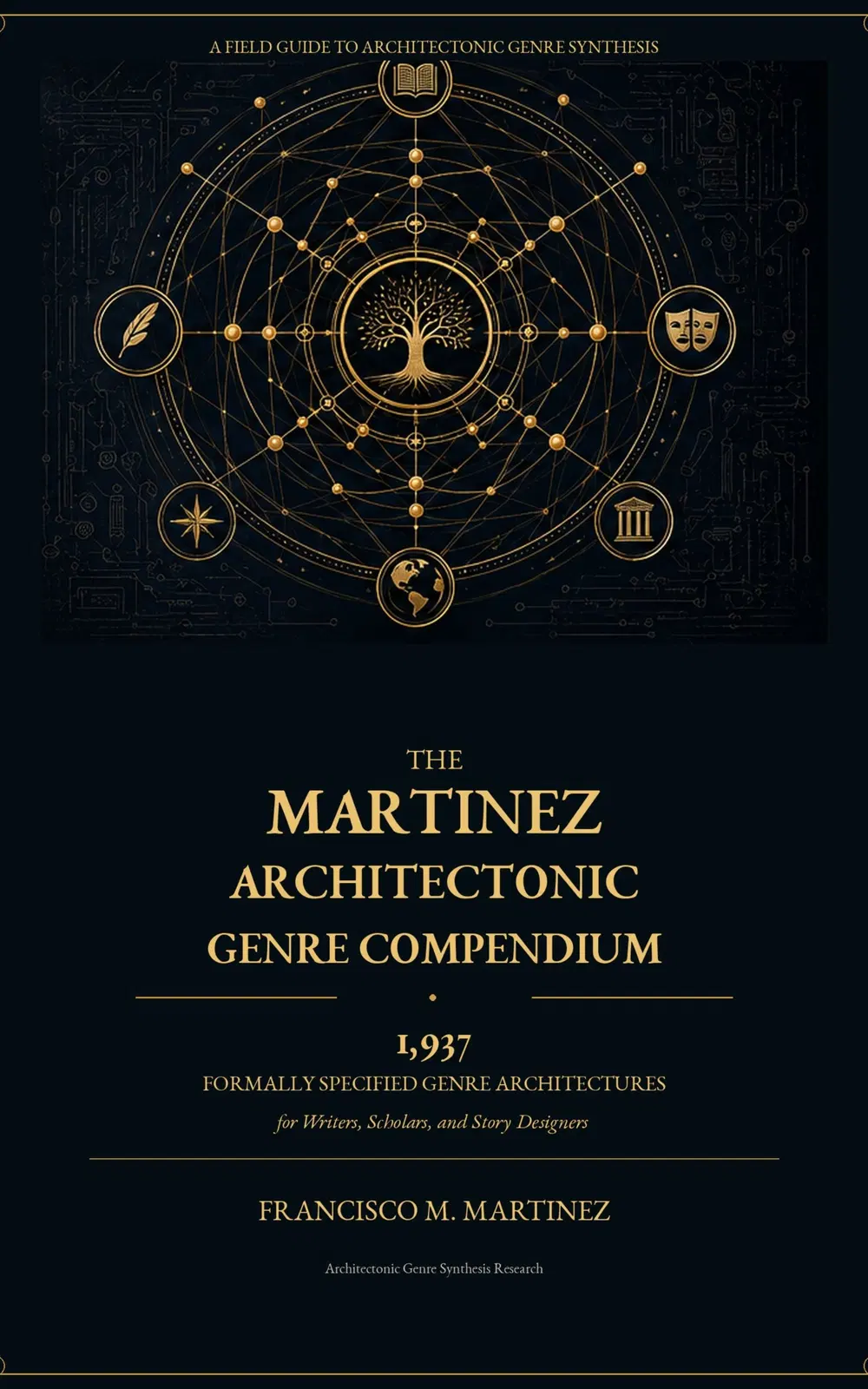
Formalizing a 1,937-Form Corpus Through a Mendel-Inspired Experimental Model
Introduces Architectonic Genre Synthesis (AGS) as a formal method for treating genre as transformable narrative architecture. The study documents the 1,937-form Martinez Architectonic Genre Corpus (MAGC), organized across 149 crossing segments, and identifies role-differentiated recurrence, operator stacking, scale escalation, surface-label convergence, and taxonomic reorganization across Mythotechnic Fiction, Meta-Mythic Delphic Fiction, Ontological Systems Fiction, and their systematic crossings.
Published: August 17, 2026 · Version 1.0
Permanent scholarly edition: DOI 10.5281/zenodo.21975417
A guide to the 35-paper Mythic Authority research program
Read how the expanding program connects Mythotechnic Fiction, machine institutions, institutional Gothic, creator ethics, post-personal authority, classification, symbolic materiality, nested awareness, resurrection economies, and life-giving authority.
 Enter Judgment Day Comics