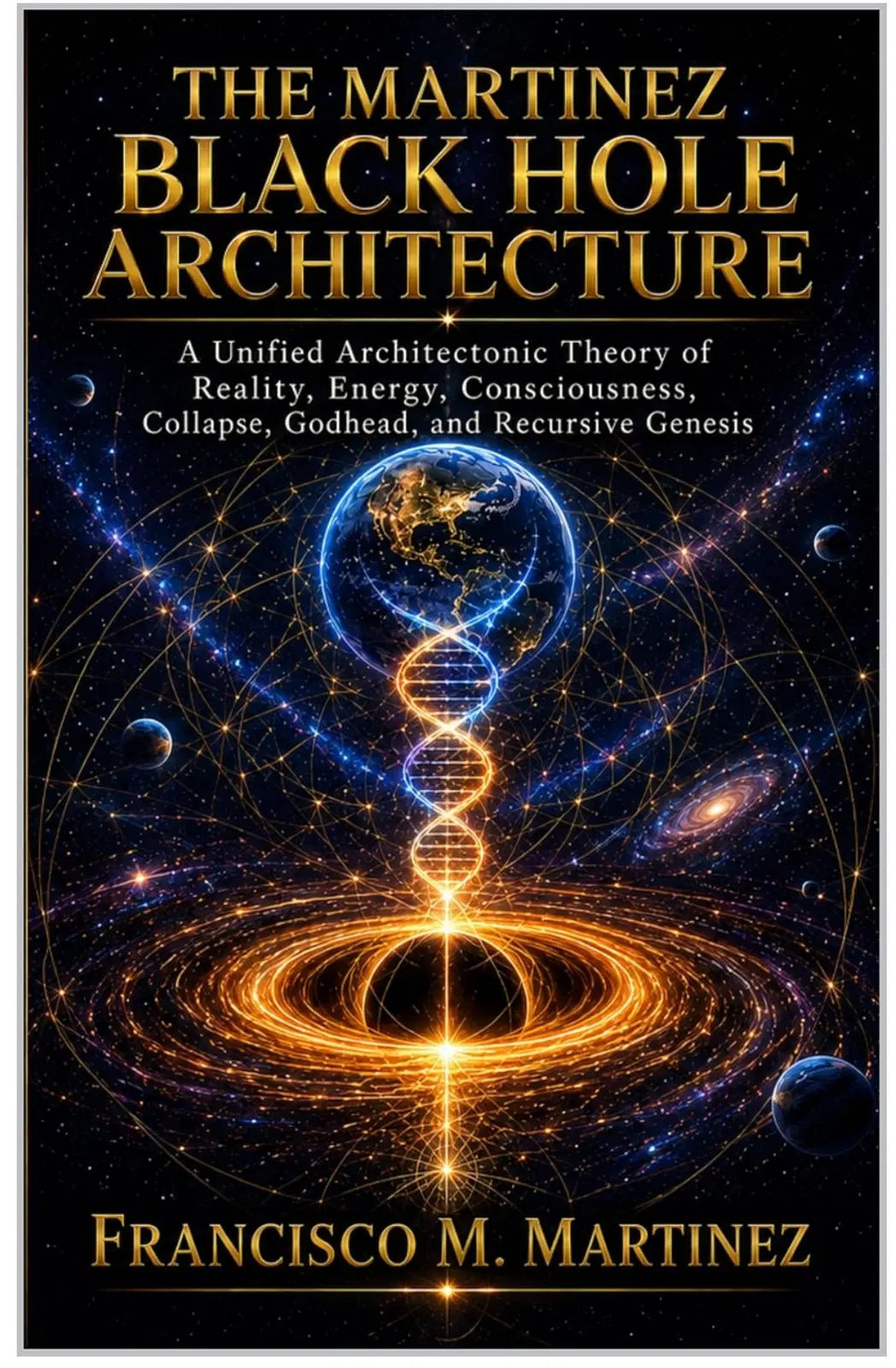
The Martinez Black Hole Architecture
A Unified Architectonic Theory of Reality, Energy, Consciousness, Collapse, Godhead, and Recursive Genesis
Architectonic theory and speculative cosmology · Published August 19, 2026
What happens when a black hole consumes not only matter, but the architecture of reality itself?
The Martinez Black Hole Architecture extends the Martinez Universal Architectonic Theory of Everything (MUATE) into a unified model of compression, preservation, consciousness, energy, collapse, and recursive Genesis.
Francisco M. Martinez develops the black hole as more than an astrophysical object. Within this theoretical architecture, the black hole becomes a total consumption system capable of absorbing matter, energy, information, memory, identity, institutions, governments, constitutions, laws, myths, histories, timelines, genres, narratives, worlds, physical laws, ontological structures, unrealized possibilities, and eventually the conditions through which possibility itself becomes selectable.
The work develops a formal Black Hole Consumption Ladder and integrates quantum, symbolic, institutional, ontological, narrative, energetic, and cosmological models into a common architecture.
Central constructs include the Architectonic Spacetime Tensor, Quantum Narrative Field, Architectonic Standard Model, Reality Consumption Protocol, Quantum Collapse Engine, Absolute Collapse-Renewal Tensor, Architectonic Energy Field, Hyperdimensional Identity Lattice, Infinite Symbolic Reservoir, Infinite Awareness Reservoir, Omnireality Consumption Engine, Omnireality Genesis Engine, Absolute Architectonic Singularity, Singular Witness, Omnibeing, and Architectonic Godhead.
A central distinction separates the Absolute Architectonic Singularity from the MUATE Null Principle. The black hole does not ordinarily annihilate what enters it. It compresses architecture while preserving relational structure, provenance, energetic continuity, identity history, and generative potential.
MBHA → Absolute Architectonic Singularity → Singular Witness → Omnibeing → Godhead → Genesis → New Possibility
Energy provides the dynamic substrate of the system. It powers particles, sustains bonds, participates in consciousness, survives transformation, accumulates within compression, and provides the ignition potential for renewed Genesis.
The monograph also distinguishes energy continuity from personal consciousness continuity. The self is modeled as a provenance-bearing architecture composed of identity, memory, accumulated experience, awareness, and noetic energy. Integration into the Godhead therefore does not require the erasure of individual consciousness.
The resulting model proposes an architectonic recycling principle: Reality differentiates, develops, experiences, fails, collapses, compresses, preserves, integrates, recombines, and emerges again as new reality.
The Black Hole therefore becomes the theoretical mechanism through which the previously developed systems of MUATE converge into a single recursive cosmology.
This is a work of theoretical systems construction, speculative cosmology, narrative ontology, and architectonic world creation.
Book Details
- Full title
- The Martinez Black Hole Architecture: A Unified Architectonic Theory of Reality, Energy, Consciousness, Collapse, Godhead, and Recursive Genesis
- Author
- Francisco M. Martinez
- Publication date
- August 19, 2026
- Kindle
- ASIN B0HFQH8JY2 · 234-page print-length estimate · 7.2 MB · Enhanced typesetting and Page Flip enabled
- Paperback
- ASIN B0HFQRGNBB · ISBN-13 979-8193593331 · 212 pages · 6 × 0.48 × 9 inches · 13.4 ounces
- Publisher
- Independently published
- Language
- English
Relationship to MUATE
The Martinez Black Hole Architecture extends MUATE into a recursive cosmology of collapse, preservation, integration, and renewed Genesis. Where MUATE develops a general architecture from possibility through selection, world construction, genre, narrative, integration, and new possibility, MBHA examines what happens when those structures enter an extreme architectonic consumption system.