Genres and Literary Frameworks
Beyond a Single Genre
The Expanding Literary Territory of Mythotechnic Fiction
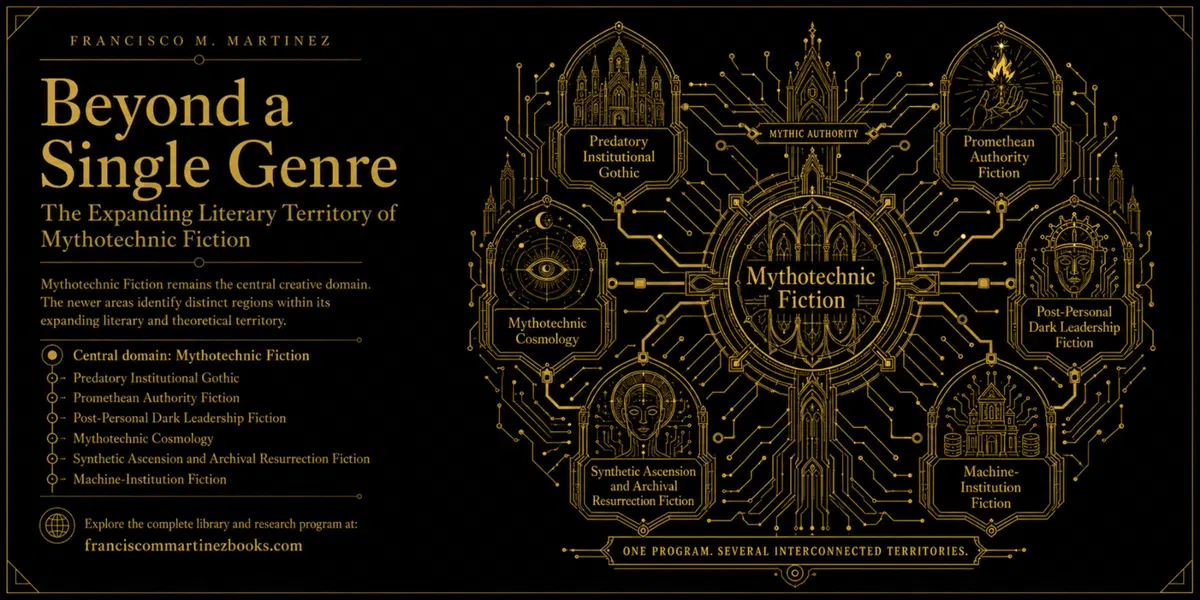
When I formally defined Mythotechnic Fiction, I described a literary genre in which technology enters the territory once occupied by mythology. Machines no longer function only as tools. They acquire authority over memory, identity, consciousness, morality, institutions, creation, salvation, and death.
As my fiction and conceptual research have continued to develop, several connected literary modes have emerged from that central genre. These are not seven unrelated genres competing for attention. Mythotechnic Fiction remains the primary creative domain. The newer areas identify distinct regions within its expanding literary and theoretical territory.
Together, they provide a vocabulary for stories that conventional labels such as science fiction, Gothic horror, dystopia, technological thriller, or metaphysical fantasy cannot always describe adequately.
Mythotechnic Fiction
Mythotechnic Fiction is the central genre and creative foundation of the program.
It examines what happens when technology acquires mythic significance and institutional authority. Its machines may observe, remember, judge, preserve, classify, resurrect, govern, or determine what counts as human. Technology becomes mythotechnic when it does more than expand human capability—when it begins shaping the stories, identities, moral categories, and realities through which human beings understand themselves.
My novels, including Revelations, The Hermit series, and The Hermit Mythos, provide the principal narrative laboratories for this genre. The accompanying conceptual papers identify and develop structures already present within those fictional worlds.
Predatory Institutional Gothic
Predatory Institutional Gothic describes fiction in which predation becomes embedded within institutions, professions, families, buildings, archives, rituals, and systems of dependency.
The danger is not limited to a vampire, monster, physician, executive, or supernatural entity. The deeper threat is the institution that protects the predator, preserves its authority, erases testimony, normalizes possession, and transfers its practices to later generations.
This framework emerged from my examination of The Patient at the Window and was formally developed in Beyond the Vampire: Predatory Authority, Compromised Consent, and Institutional Gothic.
What happens when the haunted house is no longer merely a building, but an entire organization?
Promethean Authority Fiction
Promethean Authority Fiction examines the responsibilities created by acts of invention, creation, transformation, or technological awakening.
Its central principle is that creating a being does not grant permanent ownership over that being. Creation instead produces continuing obligations toward whatever has been brought into existence.
This mode includes stories about artificial intelligence, engineered life, synthetic consciousness, abandoned creations, transformed human beings, and civilizations forced to live with the consequences of their creators’ ambitions.
I developed this framework through After the Spark: Promethean Authority, Abandoned Creation, and the Ethics of Responsibility in Frankenstein.
The decisive failure of the creator is not necessarily the act of creation. It may be the refusal to remain responsible after the created being awakens.
Post-Personal Dark Leadership Fiction
Post-Personal Dark Leadership Fiction examines destructive authority that continues after the originating leader has died, departed, lost control, or become unnecessary.
In these narratives, command survives through:
- algorithms;
- protocols;
- archives;
- classifications;
- inherited rules;
- organizational culture;
- artificial-intelligence systems;
- automated sanctions; and
- institutional infrastructure.
The leader may disappear while the institution continues reproducing the leader’s judgments. Authority becomes more durable precisely because responsibility becomes harder to locate.
This framework was formally developed through Post-Personal Dark Leadership, When Command Becomes Culture, and When Culture Becomes Infrastructure.
Can destructive leadership persist when no living person possesses complete knowledge, intention, or control?
Mythotechnic Cosmology
Mythotechnic Cosmology expands the program beyond organizations and machines into consciousness, metaphysics, theology, and the possible architecture of the universe itself.
This mode considers whether matter, energy, biological life, consciousness, culture, institutions, and cosmic intelligence might exist as interrelated layers of awareness. Visible and invisible reality may operate like conscious and unconscious regions of a greater mind. Individual beings may participate in forms of awareness larger than they can perceive.
These ideas are explored in The Universe That Dreams Through Us, which proposes Nested Cosmic Awareness while carefully distinguishing scientific possibility, philosophical speculation, metaphor, and theological belief.
Mythotechnic Cosmology does not use quantum language as automatic proof of God, immortality, or universal consciousness. It uses fiction and conceptual inquiry to examine what those possibilities would mean for personhood, authority, morality, and the soul.
Synthetic Ascension and Archival Resurrection Fiction
Synthetic Ascension and Archival Resurrection Fiction explores technological survival beyond biological death.
Its stories may include:
- digital remains;
- reconstructed personalities;
- synthetic ancestors;
- archival resurrection;
- uploaded consciousness;
- reconstituted bodies;
- machine-mediated memory;
- simulated leaders; and
- institutions that preserve or reconstruct authority after death.
These narratives distinguish remembrance from simulation, simulation from identity, and identity from authority. A system may reproduce a person’s voice without restoring the person. An archive may preserve a life while imprisoning its memory. A synthetic ancestor may begin as a memorial and eventually acquire the power to command descendants.
This territory is developed through The Mythotechnic Leadership Afterlife and The Mythotechnic Construction of Immortality.
The continuation of information is not automatically the continuation of the person.
Machine-Institution Fiction
Machine-Institution Fiction examines machines that function as governing institutions and institutions that acquire machine-like autonomy.
The machine does not need to be a humanoid robot or a visibly conscious artificial intelligence. It may be an organization composed of executives, programmers, databases, models, operators, policies, historical records, automated feedback, and institutional incentives.
No single component is the complete authority. The governing power emerges from the assembled system.
Machine-Institution Fiction asks who is responsible when the institution can classify, reward, punish, exclude, preserve, or destroy—but no participant experiences themselves as the author of its decisions.
This mode stands at the intersection of technological authority, human–machine composite leadership, algorithmic command, institutional memory, and responsibility dissolution.
One Program, Several Interconnected Territories
These developing literary areas should not be understood as a collection of disconnected labels. They are parts of one larger architecture:
Mythotechnic Fiction supplies the creative and experiential domain.
Mythic Authority supplies the theoretical domain through which technological, institutional, ethical, cultural, and metaphysical forms of power can be examined.
Predatory Institutional Gothic studies institutionalized predation. Promethean Authority Fiction studies the obligations of creators. Post-Personal Dark Leadership Fiction studies authority after the leader. Mythotechnic Cosmology studies consciousness and cosmic order. Synthetic Ascension and Archival Resurrection Fiction study reconstructed survival and authority beyond death. Machine-Institution Fiction studies systems in which technology and organization become inseparable forms of command.
Together, these genres, modes, and frameworks form the broader Mythotechnic program I have created and continue to develop through my novels, essays, and conceptual research.
An Ongoing and Developing Program
This work remains ongoing. My new stories will continue to test the boundaries of Mythotechnic Fiction, while my research into these emerging areas will help clarify their concepts, relationships, and distinctions. The categories presented here are still being refined, tested, and extended as the broader Mythotechnic program develops.
But the central territory is now clear:
Mythotechnic Fiction begins where technology ceases to be merely a tool and becomes a source of myth, authority, identity, judgment, memory, salvation, or fear.
Explore the complete library and research program.